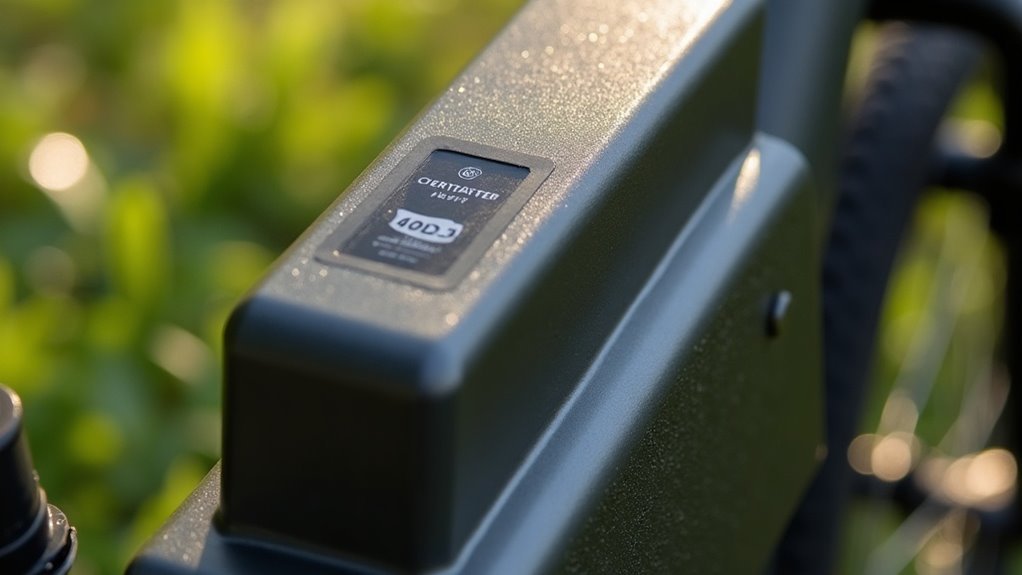
You should balance or calibrate your e-bike battery immediately after purchase, when experiencing any irregular performance issues, and after prolonged storage. Look for signs such as sudden display drops, erratic readings, or decreased range, as these indicate a need for calibration. Regular checks every few months can enhance battery longevity. Always aim to balance the battery after the first few charge cycles or if you notice unbalanced cell voltages. Understanding effective maintenance techniques can help you maximize your e-bike battery’s performance and lifespan.
Key Takeaways
- Balance new e-bike batteries immediately to ensure optimal performance from the start.
- Perform regular checks every few months to enhance battery longevity and reliability.
- Balance batteries after seasonal storage to address any charge inconsistencies.
- Recalibrate the Battery Management System (BMS) if you notice erratic display readings or decreased range.
- Conduct full charge and discharge cycles 2-3 times a year for effective battery calibration.
Why E-Bike Battery Calibration Is Essential
When you ride your e-bike, accurate charge level readings are crucial for optimal performance, making battery calibration essential.
Regularly recalibrating the Battery Management System (BMS) helps resolve performance issues, ensuring peak e-bike efficiency. By performing a complete charge and discharge cycle, you allow the BMS to reset and manage power more effectively.
This process also promotes battery balancing among individual cells, preventing imbalances that could negatively impact battery health. Calibration extends battery lifespan, so don’t overlook erratic charge readings or reduced range. Additionally, understanding the best e-bike batteries can further enhance your riding experience.
Keeping your e-bike’s battery calibrated ensures you enjoy reliable performance on all your rides.
Signs Your E-Bike Battery Needs Calibration?
How can you tell if your e-bike battery needs calibration? Watch for these signs:
| Sign | Description | Action |
|---|---|---|
| Sudden Display Drop | Percentage drops below 50% | Check calibration |
| Erratic Display Readings | Fluctuating charge levels while riding | Recalibrate as needed |
| Decreased Range | Noticeable drop in range or power output | Consider BMS adjustment |
| Regular Voltage Sag | Frequent voltage sag indicates unbalanced cells | Rebalance and recalibrate |
If you experience any of these issues, it’s time to calibrate your e-bike battery for optimal performance. Monitoring battery temperature is essential for maintaining battery health and longevity.
Optimal Timing for Balancing Your E-Bike Battery
When your new e-bike battery arrives, balancing it right away ensures optimal performance from the get-go.
If you plan to store your battery for a season, remember to balance it afterward to address any charge inconsistencies.
Conducting regular checks every few months can also significantly enhance your battery’s longevity and reliability.
New Battery Arrival
Upon the arrival of your new e-bike battery, it’s essential to balance it immediately to ensure optimal performance and longevity.
New batteries often experience imbalances due to manufacturing variations, so balancing guarantees uniform charge distribution. This prompt action prevents potential capacity loss and promotes efficient energy use right from the start.
Many manufacturers recommend checking and balancing the battery after the first few charging cycles to establish a reliable baseline.
Seasonal Storage Considerations
After ensuring your new e-bike battery is balanced, seasonal storage becomes crucial for maintaining optimal performance.
To enhance battery care during this time, follow these steps:
- Fully charge your e-bike battery before storage to prevent capacity loss.
- Utilize the Battery Management System (BMS) to monitor the health of your battery.
- Balance the cells every few months or after specific mileage to ensure even charge distribution.
- Look out for signs of abnormal behavior, such as erratic display readings, which may indicate the need for immediate balancing.
Additionally, consider using a high-quality battery charger to preserve your battery’s longevity and performance, especially one that features smart charging technology.
Must-Have Tools for Testing Your E-Bike Battery
To effectively test your e-bike battery, you’ll need essential tools that ensure precise measurements and diagnostics.
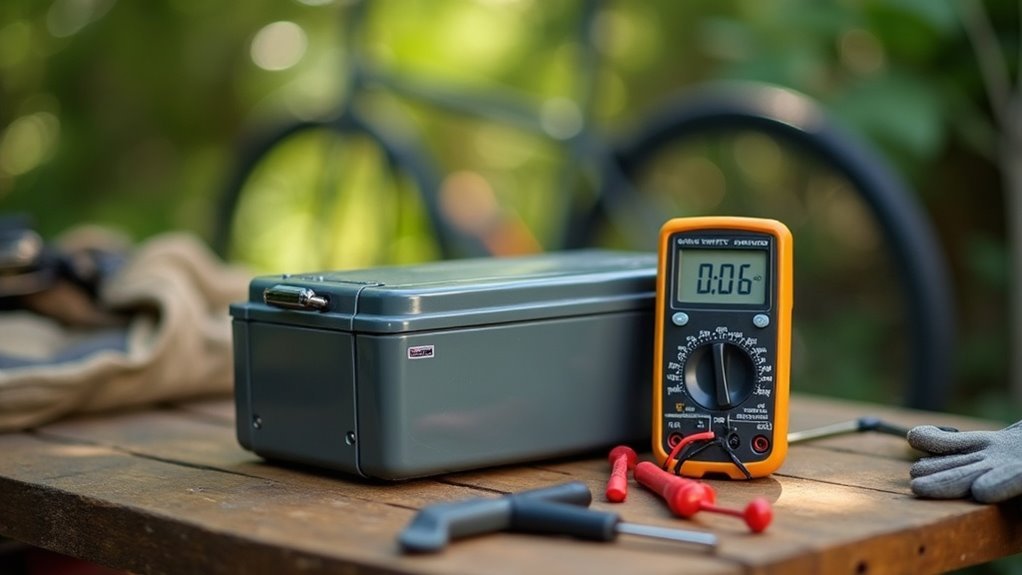
A digital multimeter, load tester, and AC impedance meter are crucial for assessing voltage, performance under load, and internal resistance.
Knowing how to use these tools is vital for maintaining optimal battery health and extending its lifespan. Additionally, using charger caddies with cord reels can help keep your testing equipment organized and easily accessible.
Essential Testing Equipment
When testing your e-bike battery, having the right equipment is essential for accurate assessments and reliable performance. Here are four must-have tools:
- Digital Multimeter: Crucial for monitoring battery voltage, current, and resistance.
- Load Testers: Simulate real-world conditions to evaluate performance under stress and detect voltage drops.
- AC Impedance Meters: Measure internal resistance, which is important for assessing the discharge capability of battery cells.
- Professional Diagnostic Tools: Offer in-depth analysis of the Battery Management System (BMS) and help identify complex issues beyond basic measurements.
Additionally, understanding the optimal battery specifications can significantly enhance your testing accuracy and battery longevity. Utilizing these tools ensures peak battery capacity and longevity.
Voltage Measurement Tools
Accurate voltage measurements are essential for assessing your e-bike battery’s performance and health. A digital multimeter allows you to measure voltage, indicating the State of Charge when the battery is fully charged. This tool works alongside the Battery Management System (BMS) to ensure optimal battery capacity.
Load testers simulate real-world conditions, revealing voltage drops under stress, which directly affect battery performance. Additionally, AC impedance meters measure internal resistance, crucial for identifying degradation.
Finally, a plug-in energy meter monitors charging efficiency, ensuring that the display reflects accurate capacity metrics. Regular checks can help prevent issues and enhance your e-bike’s reliability.
Load Testing Devices
While monitoring your e-bike battery’s performance, load testing devices are essential tools that simulate real-world conditions. They apply a resistive load, allowing you to observe voltage drop and assess battery performance under stress.
Here are four key tools:
- Digital Multimeters: Accurately measure voltage, current, and resistance.
- AC Impedance Meters: Evaluate internal resistance to check battery health.
- Load Testers: Mimic real-world usage to identify potential issues.
- Professional Testing Tools: Provide comprehensive diagnostics, uncovering deeper performance problems.
Regular use of these devices ensures your Battery Management System (BMS) effectively monitors each individual cell and battery terminals, ultimately enhancing overall battery health.
How Battery Management Systems Aid in Calibration
Battery Management Systems (BMS) are essential for calibrating e-bike batteries, as they meticulously monitor individual cell voltages to ensure balanced charging. By recalibrating the battery’s State-of-Charge (SoC) estimation, the BMS guarantees precise charge level readings. Many modern e-bike systems actively balance energy between cells, enhancing overall capacity utilization. Smart chargers work in conjunction with the BMS to pause charging during overheating, promoting safety. Regular calibration is crucial, especially after significant usage, to maintain optimal performance and extend battery lifespan.
| Feature | Benefit |
|---|---|
| Monitors Cell Voltages | Prevents overcharging |
| Recalibrates SoC | Ensures accurate readings |
| Active Balancing | Minimizes voltage discrepancies |
| Communicates with Chargers | Enhances safety during charging |
Common Mistakes to Avoid in E-Bike Battery Maintenance
Maintaining your e-bike battery properly is essential for maximizing its lifespan and performance. Here are common mistakes to avoid:
- Fully discharging your e-bike battery below 20-30% can cause irreversible damage.
- Charging to 100% consistently leads to a loss of capacity; aim for 80-85% for regular use.
- Neglecting to balance your battery cells may result in uneven charge distribution, harming performance.
- Relying solely on the battery display for charge levels is misleading; use a multimeter for accurate voltage and capacity readings.
Essential Habits for E-Bike Battery Maintenance
To ensure your e-bike battery remains in optimal condition, adopting essential maintenance habits is vital.
Regularly balance your battery every few months or after extended storage to maintain even power distribution.
Keep an eye on battery health by checking for voltage sag, which can indicate the need for immediate attention.
Follow the 80-20% rule for charging and discharging to enhance performance and reduce stress.
Conduct a full charge and discharge cycle 2-3 times a year to recalibrate the Battery Management System (BMS) and improve efficiency.
Engaging with the e-bike community can also provide valuable insights into best practices for battery care.