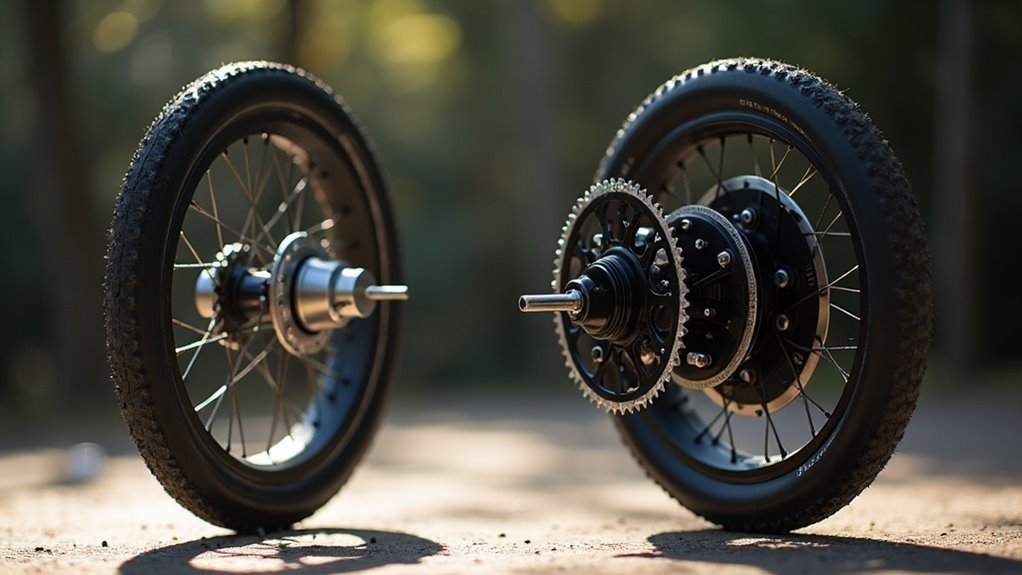
When deciding between hub and mid-drive motors for e-bikes, consider your riding needs. Hub motors are budget-friendly and ideal for flat terrains but may struggle on hills and can feel less responsive. Conversely, mid-drive motors excel in climbing efficiency, offering a more natural pedaling experience and better handling. Although they come at a higher price and require more maintenance, their performance advantages can justify the investment. To make the best choice, explore how each motor type uniquely impacts your ride.
Key Takeaways
- Hub motors are budget-friendly options for e-bikes, ranging from $1,200 to $2,500, ideal for flat terrains but may struggle with hills and handling.
- Mid-drive motors, starting around $2,000, excel at climbing, offering superior torque and a more natural cycling feel for e-bikes.
- Maintenance for hub motors is simpler due to fewer moving parts, while mid-drive systems require more frequent drivetrain repairs.
- Hub motors can add weight to the wheel, which may affect stability, whereas mid-drives enhance handling and provide a dynamic ride experience.
- Test rides are essential for evaluating e-bike motor performance, especially regarding climbing ability and overall riding comfort.
What Challenges Do Riders Face With Hub and Mid-Drive Motors?
When choosing between hub and mid-drive motors for e-bikes, you’ll encounter specific challenges that can influence your riding experience.
Hub motors often struggle with climbing hills due to a lack of gearing, leading to reduced efficiency and potential overheating.
Hub motors can struggle with hill climbing, often resulting in inefficiency and overheating due to their lack of gearing.
In contrast, mid-drive motors can increase drivetrain wear, resulting in higher maintenance costs on technical terrain.
Hub motor e-bikes tend to be heavier, complicating handling and flat repairs.
Additionally, the direct power delivery of hub motors can create an abrupt riding experience, while mid-drive systems require shifting skills and may be noisier, posing challenges for less experienced riders.
Choosing the perfect hydraulic brake caliper can also impact your overall riding experience and safety on varying terrains.
Why Choose Mid-Drive Motors?
Mid-drive motors are particularly advantageous for e-bikes, as they excel in climbing efficiency by utilizing the bike’s gears. This allows you to tackle steep inclines with ease.
The design enhances torque and provides a more natural riding experience, closely resembling traditional cycling. Additionally, with their centralized weight distribution, mid-drive motors improve handling and stability, making them ideal for various terrains. Furthermore, choosing the perfect battery for your e-bike can significantly impact performance and range, as a quality battery is essential for maximizing your ride’s potential.
Enhanced Climbing Efficiency
For riders tackling steep inclines on electric bicycles (e-bikes), enhanced climbing efficiency is crucial, and choosing a mid-drive motor can make all the difference.
Mid-drive motors utilize the bike’s gears, providing superior torque and power delivery compared to hub motors. This gearing advantage ensures optimal RPM, improving battery life and preventing overheating during prolonged climbs.
The centralized weight distribution of mid-drive systems enhances bike handling, offering stability on challenging terrain. Consequently, you can tackle longer, steeper routes with less strain, maximizing your performance.
With mid-drive motors, climbing efficiency becomes a reality, making them the superior choice for hilly and off-road conditions. Additionally, choosing the perfect bottom bracket can further optimize your bike’s performance in demanding situations.
Natural Riding Experience
Choosing a mid-drive motor significantly enhances the natural riding experience on e-bikes. Here’s why you should consider them:
- Natural Pedaling Feel: Mid-drive motors leverage your bike’s gears, delivering smooth, consistent power that closely resembles traditional cycling.
- Improved Handling: The centralized weight distribution enhances agility and maneuverability, especially on diverse terrains.
- Optimized Efficiency: These motors maximize power use, extending your range and ensuring comfort, particularly on inclines. Additionally, they often pair well with the right battery charger, ensuring your e-bike remains charged and ready for longer rides.
With mid-drive motors, you’ll experience superior climbing ability and longer rides, making your e-bike journey both enjoyable and efficient.
Comparing Costs: Hub Motors vs. Mid-Drive Motors
When comparing costs for e-bikes, hub motors typically present a lower initial purchase price, often ranging from $600 to $1,000 less than mid-drive systems.
While the upfront savings can be appealing, it’s important to consider long-term maintenance costs—hub motors require less upkeep, which may lead to lower overall ownership expenses.
However, mid-drive motors might justify their higher price with superior performance on varied terrains, making them a worthwhile investment for more serious e-bike riders. Additionally, electric bike performance can significantly impact your riding experience, influencing your choice between motor types.
Initial Purchase Price
The initial purchase price of e-bikes can significantly influence your decision between hub and mid-drive motors. Here’s a breakdown of costs:
- Hub Motors: Typically range from $1,200 to $2,500, making them more budget-friendly upfront.
- Mid-Drive Motors: Generally start at around $2,000, with prices reaching up to $3,500 due to their advanced design and performance capabilities.
- Cost Considerations: While hub motors are more economical initially, mid-drive motors provide superior performance, appealing to serious riders.
Understanding these price differences is crucial for assessing your budget and considering the long-term ownership experience, especially regarding potential maintenance expenses.
Long-Term Maintenance Costs
Understanding long-term maintenance costs is essential for making an informed decision between hub and mid-drive motors for e-bikes.
Hub motors generally have lower maintenance costs due to their simpler design and fewer moving parts, resulting in less drivetrain wear.
In contrast, mid-drive motors, while offering superior performance and efficiency, lead to increased drivetrain wear, often necessitating chain and cassette replacements every 4,000 miles.
Repairs for hub motors can be complex, especially concerning electrical connections, whereas mid-drive repairs focus on drivetrain components.
Although mid-drive systems may incur higher maintenance frequency, their efficiency can enhance battery life, potentially balancing some long-term costs for dedicated e-bike riders.
How Do Hub and Mid-Drive Motors Perform Differently?
While both hub and mid-drive motors enhance cycling performance, their operational differences significantly impact your e-bike riding experience. Here’s how they compare:
- Power Delivery: Mid-drive motors utilize gears for higher torque, making climbs easier, while hub motors provide direct push, which is ideal for flat terrain.
- Weight Distribution: Mid-drive motors are centrally located, improving balance and handling; hub motors add weight to the wheel, potentially affecting stability.
- Efficiency: Mid-drive motors offer better energy efficiency, extending your range, while hub motors may struggle on inclines due to their fixed gearing.
These factors notably influence your riding feel and maintenance needs, shaping your overall e-bike experience.
Maintenance Tips for Hub and Mid-Drive Motors
Maintaining your e-bike’s motor—whether hub or mid-drive—is crucial for optimal performance and longevity. Here are essential maintenance tips to keep in mind:
| Maintenance Aspect | Hub Motors | Mid-Drive Motors |
|---|---|---|
| Regular Inspections | Check spokes and rims for damage | Inspect drivetrain for chain wear |
| Lubrication | Minimal needed due to sealed design | Regularly lubricate chain and gears |
| Battery Care | Charge regularly; store in a cool place | Same as hub motors |
| Flat Tire Repairs | Complex, requiring electrical disconnection | Easier access for wheel removal |
Choosing the Best Motor Based on Your Riding Style?
Choosing the Best Motor for Your E-Bike Riding Style
How do you select the best motor for your e-bike riding style? Consider these key factors:
- Terrain: For steep hills, mid-drive motors excel with superior torque and gear utilization, enhancing efficiency on challenging inclines.
- Commuting Type: If your focus is urban commuting, hub motors provide a cost-effective, low-maintenance solution, ideal for flat surfaces and city riding.
- Handling and Feel: Mid-drive motors offer a more natural pedaling experience and improved handling, making them perfect for dynamic, varied rides.
Ultimately, test rides are crucial to determine which motor best fits your specific needs—whether it’s climbing capabilities or ease of maintenance.
Choose wisely to enhance your e-bike experience!