
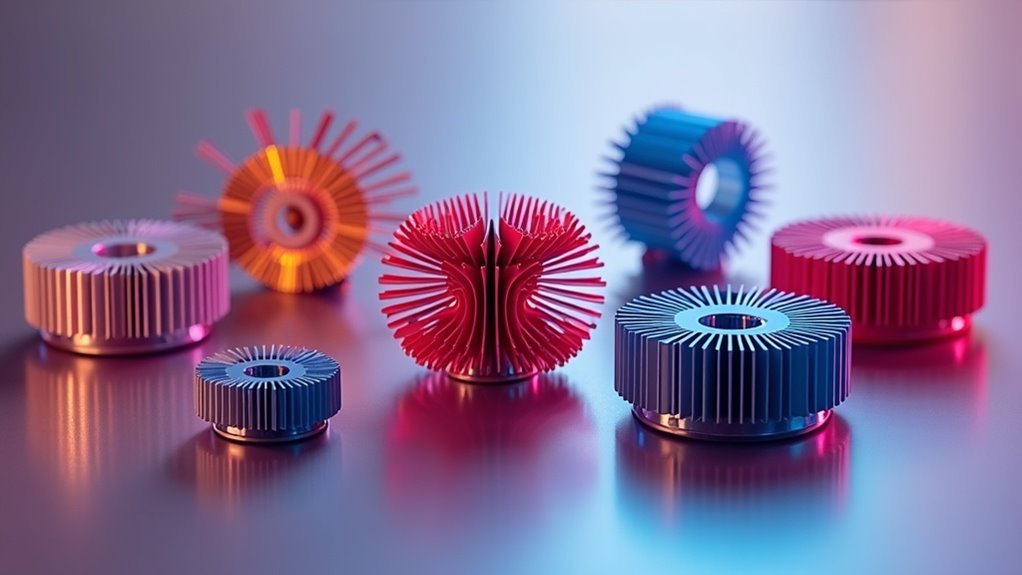
To maximize your cooling efficiency in rotor systems, you should consider the top heat sinks of 2025. Options like the TO-220 Heatsink Kit and the Easycargo Round Aluminum Heat Sink deliver exceptional performance. The Motor HeatSink for Delavan FB Series Pumps offers specialized design for electric applications. Additionally, the 10PCS TO-220 Heatsink guarantees peak voltage regulation. Each choice balances material, size, and thermal conductivity, helping manage heat effectively. Stay tuned for more detailed insights on these top picks.
TO-220 Heatsink Kit (12 Pack)

If you’re working with TO-220 power semiconductor packages, the TO-220 Heatsink Kit (12 Pack) is an essential addition to your toolkit. This kit includes 12 black anodized aluminum heatsinks designed for efficient heat dissipation. Each heatsink measures 20mm x 15mm x 11mm, providing compatibility with voltage regulators like LM78XX and MOSFETs such as IRFXXX. The insulation kits come with screws, insulating bushings, and rubberized silicone insulators, ensuring easy installation. With an average rating of 4.3 stars, users appreciate its performance, though some mention issues with screw fit. Overall, it’s a reliable choice to enhance your cooling efficiency.
Best For: This product is best for electronics enthusiasts and professionals working with TO-220 power semiconductor packages who need efficient heat dissipation solutions.
Pros:
- Effective heat dissipation for TO-220 power semiconductor packages.
- Included insulation kits streamline installation with screws and insulating components.
- High customer satisfaction reflected in an average rating of 4.3 out of 5 stars.
Cons:
- Some users report issues with screw fit and sizing expectations.
- Limited to specific semiconductor types, which may not suit all applications.
- Weight may be a concern for lightweight designs, as each heatsink weighs 0.05 kilograms.
Easycargo Round Aluminum Heat Sink for LED Diodes

The Easycargo Round Aluminum Heat Sink is an excellent choice for DIY enthusiasts and professionals working with LED diodes and power electronics. With a compact design featuring a 0.23-inch inside diameter and 0.8-inch outside diameter, it effectively dissipates heat, handling around 3 watts of power. You’ll appreciate the included 10 pieces, perfect for various applications, including creative uses like candle holder legs. Just keep in mind that the screw holes measure 19mm, which may not fit all MCPCB LEDs. Overall, this versatile heatsink offers reliable performance, making it a solid addition to your projects.
Best For: DIY enthusiasts and professionals looking for an effective heat sink solution for LED diodes and power electronics.
Pros:
- Effective heat dissipation for LED and power applications, handling approximately 3 watts of power.
- Versatile usage, adaptable for creative projects like candle holder legs.
- Includes 10 pieces in a package, providing ample options for various applications.
Cons:
- Screw holes measure 19mm, which may not be compatible with all MCPCB LEDs.
- Can get very hot during extended use, posing a burn risk if not handled carefully.
- Original compatibility expectations for SST20 LEDs may not be met, requiring alternative attachment methods.
Heat Sink

For those who frequently solder components in tight spaces, the Best Rotor Heat Sink of 2025 stands out with its large absorption area and durable spring steel construction. This heat sink effectively protects your components and wires from high heat, making it ideal for fixing or creating cables and soldering germanium transistors. Weighing just 1.28 ounces and measuring 7 x 5 x 7 inches, it’s compact yet powerful. With a strong customer rating of 4.6 stars, users praise its effectiveness in preventing solder wicking. Plus, with a 30-day return guarantee, you can confidently try it out for your projects.
Best For: Individuals who frequently solder components in tight spaces and need reliable heat protection for their projects.
Pros:
- Effective heat protection: Prevents solder wicking and heat migration, ensuring clean soldering.
- Compact design: Lightweight and small dimensions make it easy to handle in confined areas.
- High customer satisfaction: Strong rating of 4.6 out of 5 stars based on user feedback.
Cons:
- Limited size options: Some users wish for a kit that includes various sizes for different applications.
- No included batteries: Requires no batteries, which may be inconvenient for some users expecting a complete kit.
- Best Sellers Rank: While ranked well in its category, it may not be as widely recognized outside of automotive applications.
Motor HeatSink Compatible with Delavan FB Series Pumps

Engineered specifically for Delavan FB Series Pumps, the Motor HeatSink stands out as an essential upgrade for anyone using MY1020, MX650, MX500, or SX500 dirt bike motors. Its compact dimensions of 3.75 X 3.95 inches make it perfect for electric applications like bicycles and scooters. The aluminum alloy construction guarantees excellent thermal conductivity, dissipating heat 2.5 times more efficiently than cast iron. Users report a significant reduction in motor temperature, extending motor life by up to 50%. For ideal results, consider applying thermal paste. This heatsink not only boosts performance but also enhances the aesthetics of your setup.
Best For: Anyone using Delavan FB Series Pumps or compatible dirt bike motors looking to enhance cooling efficiency and extend motor life.
Pros:
- Reduces motor temperature, potentially extending motor life by up to 50%.
- Lightweight aluminum construction provides excellent thermal conductivity and heat dissipation.
- Snap-in design optimizes airflow, improving overall pump efficiency.
Cons:
- May require thermal paste for optimal effectiveness, adding to installation complexity.
- Compatibility is limited to specific models within the Delavan FB Series and select dirt bike motors.
- Aesthetic enhancement may not be a priority for all users, making it a less appealing feature for some.
10PCS TO-220 Heatsink for MOSFET Voltage Regulator

If you’re working on a project that involves MOSFET voltage regulators, these 10PCS TO-220 heatsinks are an excellent choice to enhance performance and efficiency. Each heatsink measures 15mm x 20mm, perfectly sized for TO-220 packages. Made from silver, they guarantee superior thermal conductivity, keeping your MOSFETs cool under load. With a package of ten, you’ll have plenty of heatsinks for multiple applications. Installing these will help maintain stable voltage regulation, improving your project’s reliability. Don’t compromise on cooling; invest in these heatsinks to maximize your system’s potential and guarantee long-lasting performance.
Best For: DIY electronics enthusiasts and engineers looking to improve the thermal management of their MOSFET voltage regulators.
Pros:
- Superior thermal conductivity due to the silver material, ensuring efficient heat dissipation.
- Compact size of 15mm x 20mm makes them ideal for TO-220 packages, fitting snugly in various projects.
- Cost-effective package of 10 heatsinks, providing ample supply for multiple uses or replacements.
Cons:
- Limited to TO-220 packages, which may not suit all types of voltage regulators.
- May require additional mounting hardware, which is not included in the package.
- Potential for over-reliance on heatsinks without considering other cooling methods in high-load scenarios.
Pastall 100 PCS Heatsink Kit for Raspberry Pi

The Pastall 100 PCS Heatsink Kit is the ultimate choice for Raspberry Pi enthusiasts and DIY electronics projects. This kit includes 80 aluminum and 20 copper heatsinks in eight sizes, ensuring you’ll find the perfect fit for your Raspberry Pi models. You’ll experience significant temperature reductions—like a drop from 83C to 65C for RX6400s—thanks to its high-performance thermal adhesive. Installation is straightforward, though tweezers will help with placement. Plus, its versatility extends beyond Raspberry Pi, working well with laptops and gaming consoles. Overall, this kit offers excellent value and effective cooling solutions for all your electronics needs.
Best For: Raspberry Pi enthusiasts and DIY electronics hobbyists looking for effective cooling solutions.
Pros:
- High-performance thermal adhesive ensures strong attachment and significant temperature reductions.
- Versatile kit includes a variety of sizes suitable for different projects beyond Raspberry Pi.
- Excellent value with 100 heatsinks included, combining both aluminum and copper options.
Cons:
- Adhesive can be challenging to reposition if misaligned during installation.
- Some users suggested improvements in adhesive strength for better durability.
- Tweezers are recommended for precise placement, which may not be accessible to all users.
WAVLINK Heatsink 880F for M.2 NVMe PCIe and SATA SSD

Designed specifically for gamers and PC builders, the WAVLINK Heatsink 880F offers exceptional cooling for M.2 NVMe PCIe and SATA SSDs. Supporting both 2280 configurations, it’s compatible with various setups, including ATX and Mini-ITX. With a cooling efficiency boost of up to 35%, it effectively reduces the main control chip temperature by about 18 degrees Celsius, preventing throttling. The aluminum design optimizes heat dissipation, while the low-noise fan spins at 7,000 RPM for quiet operation. Plus, low-viscosity silicone pads guarantee excellent thermal conductivity, protecting your SSDs without damage. Elevate your performance with this impressive heatsink!
Best For: Gamers and PC builders seeking efficient cooling solutions for their M.2 NVMe PCIe and SATA SSDs.
Pros:
- Excellent cooling efficiency with up to 35% improvement and a temperature reduction of 18 degrees Celsius.
- Durable aluminum design enhances heat dissipation and protects against physical damage.
- Low-noise fan operating at 7,000 RPM ensures quiet performance while maximizing cooling.
Cons:
- Not compatible with laptops or gaming consoles like the PS5.
- Adjustable height may not fit all cases perfectly, depending on specific configurations.
- Installation may require additional effort for those unfamiliar with PC hardware.
Factors to Consider When Choosing Rotor Heat Sinks
When choosing rotor heat sinks, you’ll want to take into account several key factors. Material and durability play an essential role in performance, while size and dimensions must fit your specific setup. Don’t forget to evaluate thermal conductivity, mounting options, and compatibility with your components to guarantee peak cooling.
Material and Durability
Choosing the right rotor heat sink involves understanding the material and durability factors that can greatly impact performance. Typically, you’ll see aluminum or copper as the main materials. Copper excels in thermal conductivity, offering better heat dissipation than aluminum; however, aluminum is lightweight and corrosion-resistant. Durability matters too—heat sinks must endure high temperatures and mechanical stress. Surface treatments like anodizing or powder coating can enhance corrosion resistance and improve thermal performance by maximizing surface area. Consider the thickness of the material as well; thicker heat sinks absorb and dissipate heat more effectively, though they add weight. Opt for high-quality manufacturing processes to guarantee smooth finishes and tight tolerances, vital for ideal contact with heat-generating components.
Size and Dimensions
To guarantee effective heat dissipation in rotor systems, matching the size of the heat sink to the rotor’s dimensions is essential. A larger heat sink provides more surface area, enhancing cooling efficiency through increased airflow contact. However, consider the thickness of the heat sink; while a thicker design can boost heat absorption, it might add weight and complicate mounting options. The height of the heat sink also plays a significant role, as it should permit adequate airflow around the rotor while avoiding interference with other mechanical components. Finally, standard dimensions for heat sinks should be adhered to, ensuring compatibility with existing designs and ideal thermal management. Making the right size choices will ultimately improve your rotor system’s performance.
Thermal Conductivity
Thermal conductivity plays an essential role in the effectiveness of rotor heat sinks. It measures a material’s ability to conduct heat, with higher values indicating better heat transfer. For ideal performance, you should choose materials with high thermal conductivity, like aluminum and copper, which effectively dissipate heat from electronic components. Generally, a thermal conductivity value above 200 W/m·K is excellent for high-performance applications. Remember, the effectiveness of your heat sink largely depends on the material’s thermal conductivity, directly influencing how quickly heat can be transferred away from critical components. Additionally, don’t overlook the thermal interface material (TIM) between the heat sink and the component, as it can considerably impact overall thermal conductivity and heat transfer efficiency.
Mounting Options
When selecting a rotor heat sink, it’s important to contemplate the mounting options available, as they can considerably impact both installation and thermal efficiency. You can choose from various designs like panel mounts or screw-in options, ensuring secure attachment to surfaces. Snap-in designs can optimize airflow and surface area, boosting thermal performance. Consider how the mounting type affects ease of installation and maintenance, as well as heat dissipation efficiency. Some kits include insulating materials to prevent electrical conduction, enhancing safety during operation. Remember, proper alignment and secure mounting are essential to maximizing thermal conductivity and ensuring your heat sink effectively dissipates heat from rotor components. Choose wisely to fit your specific needs!
Compatibility With Components
Compatibility with components is vital for selecting the right rotor heat sink. First, make sure the heat sink’s dimensions match your rotor or motor components; mismatched sizes can cause inefficient heat dissipation and even damage. Next, check the mounting type to confirm it aligns with your rotor’s design, as improper mounting can hinder thermal performance. It’s also important to verify that the heat sink material provides adequate thermal conductivity; materials like aluminum are typically better for heat dissipation. Don’t forget to take into account the weight of the heat sink, as heavier parts can affect the rotor’s balance. Finally, assess the airflow around the rotor and heat sink, since restricted airflow can greatly reduce cooling efficiency, regardless of compatibility.
Design and Aesthetics
After ensuring your rotor heat sink fits well with your components, it’s time to contemplate its design and aesthetics. The design should optimize airflow and maximize surface area to enhance heat dissipation. Consider finishes like anodized aluminum, which improve corrosion resistance while adding visual appeal. Larger heat sinks with intricate designs generally perform better than smaller, simpler ones. Color also impacts thermal performance; darker shades may absorb more heat, while lighter ones reflect it, influencing your cooling strategy. Ultimately, integrating design elements like grooves or fins can boost heat transfer efficiency, making your heat sink both functional and visually striking. Balancing performance with aesthetics can elevate your entire setup.